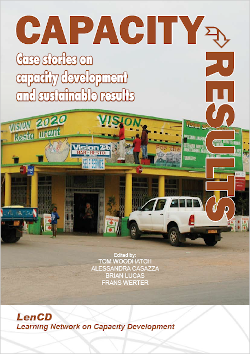
Capacity → Results: Case stories on capacity development and sustainable results
Results from investments in capacity development matter. They matter to those who are at the receiving end of public services provided by state institutions in developing countries, including health, education, water and sanitation, transport, justice and many others. Results also matter for the achievement of the MDGs, when we are two thirds of the way towards the 2015 finishing line. Both developing countries and development partners agree on the importance of results and, over the years, have strived to uphold, in policy and practice, the principle of managing for development results.
While there is consensus on the importance of results, development actors in countries and in development organisations face challenges with capturing them. The results frameworks that are widely adopted in development practice are most often founded on ‘hard’ results. Results such as number of schools built, water wells dug, roads constructed, and others alike, are easier to measure, can be achieved in a relatively short time and, most importantly, are easier to communicate to governments’ constituencies and tax-payers. However, such results frameworks have usually proven to be unsuitable to capture results deriving from longer and more complex processes of capacity development, such as nurturing inclusive ownership, accountability and change in organizational performance.
Capacity development is at the core of development; it has to do with political processes and cultural and societal changes. These processes produce long-lasting transformation, but they are also long-term and very complex in nature. While results from these processes take a long time to come about, they nevertheless manifest themselves at different levels and at different times. Results frameworks that are designed for a limited set of shorter term and hard results, are not suitable to capture the more complex changes that are rooted in investments in capacity development.
Against the background of this discussion about sustainable results, capacity development and results frameworks, LenCD has prepared a joint statement on results and capacity development (presented in this publication), which stresses that meaningful, sustainable results are premised on proper investments in capacity development and that these results materialize at different levels and at different times, along countries’ development trajectory.
To provide evidence in support of this statement, LenCD launched a call for submission of stories. The 15 stories featured in this publication have been selected by a four-member review panel, through a rigorous appraisal process of over 40 stories, received as a response to the LenCD call. The stories have been contributed by different countries and development partners and cover 14 countries in Africa, Asia and the Pacific, Europe and Latin America.
The stories showcase how endogenous investments in capacity development have led, over time, to produce short, medium and long-term sustainable results. They tell how investments in leadership capacity, coalition for change, multi-stakeholder platforms, information management systems, knowledge and skills, accountability mechanisms and others, have led, over time, to better performing public institutions, local governments, communities, small enterprises and civil society organizations; and how these, in turn, have contributed to better health services and outcomes, economic policies, business environments for small enterprises, education services and other sustainable development results that have benefited the people.
While these stories help to broaden the knowledge base on how investments in capacity lead to results, much more needs to be done, to capture the results from investments in capacities with frameworks that allow developing countries the time and the space to develop broad-based capacities and to bring these process to full fruition. We would like to thank all our partners that have supported and contributed this discussion with their own stories and perspectives, and we look forward to bringing this agenda forward together with LenCD partners, broadening the body of experiences on capacity and results and addressing the challenges that partners are still facing with capturing such results with concrete solutions.
Contents
- ALBANIA – Strengthening local government in the Kukës region
- ASIA AND THE PACIFIC – The Asia-Pacific Development Center on Disability
- BHUTAN – Building capacities to build revenues
- ETHIOPIA – Building capacity for aid management
- GUINEA-BISSAU – Supporting development of the education system
- KENYA – National capacity for policy analysis and research: the Kenya Institute for Public Policy Research and Analysis
- LAO PDR – Entrepreneurs driving productivity and capacity in smallholder rice farming
- Nigeria – The Interfaith Mediation Centre
- Papua New Guinea – Creating capacity for decentralized service delivery
- Paraguay – Improved coordination for poverty reduction
- São Tomé e Príncipe – Building an effective healthcare system
- SIERRA LEONE – The improvement of service delivery through decentralization and capacity building in Sierra Leone
- UGANDA – Using multi-stakeholder processes for capacity development in an agricultural value chain
- ZAMBIA – Support to the water sector
- ZAMBIA – Building capacity of small and medium-sized businesses: the Zambia Chamber of Small and Medium Business Associations
Editors: Tom Woodhatch, Alessandra Casazza, Brian Lucas, Frans Werter
Year of publication: 2011
Download PDF 2.1 MB